FAQs
Buy a plot in our next project
Create your own new woodland
Become a custodian/volunteer
Donate
Got a question?
One of our aims is to share our knowledge and experience with others who are planning or undertaking nature recovery projects. Below we include some of the lessons we have learned so far and expand on the thinking behind our approach. We would be delighted to talk to others who are also creating woodlands. Who knows? Perhaps we can even partner on future projects together.
How do you know which trees to plant?
There are a number of different opinions as to which trees are best to plant for the future. They broadly fall into those believing that it is best to plant native trees that are sourced as locally as possible to the site and those that think we now need to account for global warming and source tree species that are currently native to warmer latitudes.
The argument for the former is that locally sourced plants will be best adapted to the local environment, soils, climate etc., and will therefore establish themselves and thrive. Alternatively, according to the Foresty Commission, in fifty to a hundred years’ time the environment in Somerset will be similar to one you today would find a few degrees of latitude south, and so trees sourced from these areas are more likely to survive. It is difficult to know which approach will give the best long term survival outcome. However in the medium term we can observe which species are doing well locally and so we have chosen to plant a mix of locally prevalent species in the majority. This also meets with the funding criteria of both the Forestry Commission and the Woodland Trust. We are hedging our bets a little though, by planting 10-20% sweet chestnuts, which are native to the Mediterranean.
What are you doing to encourage biodiversity?
Flora and fauna indigenous to England are adapted to the habitats created by native trees which in England are primarily broadleaf species. So by creating these habitats we can preserve and boost biodiversity. The key is to create a variety of habitats that will appeal to as broad a range of birds, bugs and woodland plants as possible. To do this we are planting a mix of tree types and of shrubs and bushes. We are also creating different types of woodland including, groves of high forest, open wooded areas, coppiced stands, glades and a natural pond generated by the building of a leaky dam. We also plan to minimise the use of artificial chemicals on our site such as pesticides, herbicides and fertilisers, though we are practical enough to accept that if these are critical to the survival of the woodland then we will use them to the minimum extent necessary.
Why did you plant so many trees?
It has been demonstrated that by planting trees at close centres they compete and grow more quickly than they otherwise would. We planted at between 2.0 and 2.5 m centres at a density of around 1,600 trees per hectare. Planting at high density also takes into account that over time there will be some losses. In our first two years, they were running at less than 5%.
Were the trees planted in straight lines?
We did not plant the trees in the straight lines that are used in commercial forestry plantations as we are not growing the trees to harvest. Instead, we planted the various tree species in clusters to mimic the way that woodlands naturally form. Over time the density will naturally drop with the aim that it will eventually become the familiar English woodland that we are aiming for.


Why didn't you plant larger, more mature trees?
In urban environments and in gardens larger specimen trees are often planted to establish the landscaping as quickly as possible. However for a large woodland creation project such as this it is neither practical or necessary to do so. Planting 1- or 2-year-old whips at high densities encourages them to grow quickly and within a few years they will have caught up and overtaken the progress of larger specimens.
Why haven’t you decided to rewild the field?
Rewilding projects across the country have demonstrated tremendous results in terms of nature recovery and biodiversity improvements and these examples very much inspired us to start this project.
We are incorporating some elements of rewilding into the scheme, for instance within some clearings within the existing woodland.
However our research into rewilding leads us to conclude that our 4.6 hectare plot was a bit too small and that we were not in a position to tend the range of animals that have contributed to the success of projects like the Knepp estate.
For us too, the number one priority is establishing trees to combat global warming and by planting our trees rather than waiting for them to regenerate naturally, we will get there faster.
Couldn't you allow the field to naturally regenerate?
One approach would be to simply allow the land to regenerate by itself, with self-seeded trees gradually recolonising the field. In fact since grazing stopped on the field in mid-2023 we have already discovered many tiny self-seeded oak trees. We found this a very appealing idea but were put off by the danger to young trees that deer and other animals present. Unless a very high fence with an apron to stop burrowing animals is erected to keep deer and rabbits out the survival rate is likely to be low and woodland establishment slow. We have however protected around 100 self-seeded oaks with tree guards and plan to do the same next growing season so that there will be an element of natural regeneration along with the new planting.
How did you protect the trees?
There are up to two million deer in the UK. Several have been spotted in the vicinity of the West Field and will graze on young trees stunting their growth or killing then if left unprotected. Rabbits and badgers also graze on young trees. We used plastic tubes to protect the young saplings while allowing light in. In this we have been generously supported by the manufacturer – Tubex. Once the trees have emerged out of the tops of the tubes we will remove them. Tubex guarantees to collect and recycle them free of charge.
How are you caring for the trees while they are young?
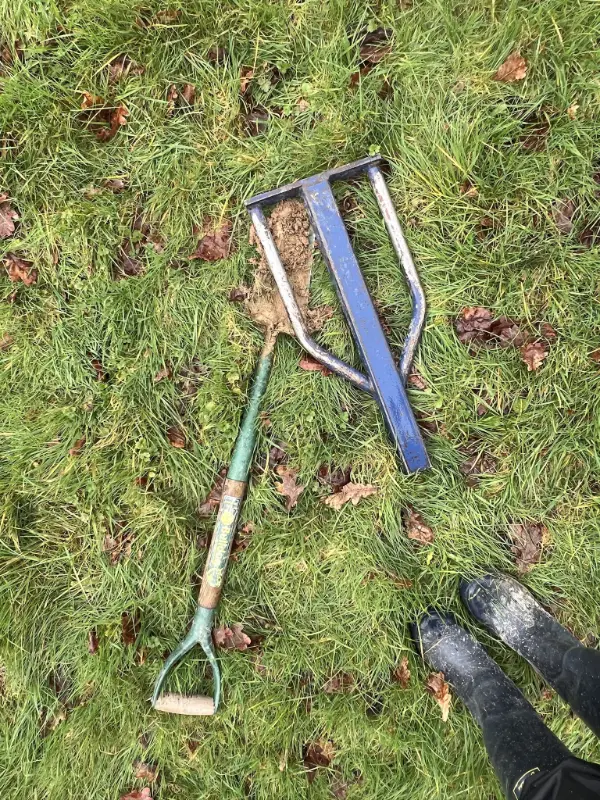
We ‘screefed’ the ground before planting the trees. This was a word that was new to us. It means that a small patch of ground is quickly scuffed clear of grass and weeds in the area around where the tree will be planted. In the early years we will continue to remove weeds and grass from within the tree tubes in order to reduce competition.
It was suggested we put mulch down the tubes to help keep them weed free. Instead we have done this by weeding the tubes from time to time.
We will also check the stakes and guards periodically and right any that have been blown over or are no longer vertical.
What other risks and hazards are there to growing a healthy woodland?
Unfortunately there are a number of risks to the growth of the trees and it is inevitable that a proportion will not survive.
The saplings are being sourced from Heydon Hill nursery nearby. This is a certified disease-free nursery and we are avoiding planting species such as ash for instance which area at risk of known diseases.
Unpredictable weather such as storms and droughts are becoming more prevalent as a result of the growing climate crisis, and we are mitigating against these to a degree by planting over two winters.
Grey squirrels are also a significant threat to woodland once it reaches about ten years old. Squirrels strip bark and often ‘ring bark’ trees which cuts off the transport of water and nutrients between foliage and roots. This can stunt growth or result in death. The plague of squirrels in the UK is now a major threat to woodland. There are national schemes under consideration to control squirrel numbers but currently in our area trapping is the only effective control.
How much CO2 will the woodland sequester?
The Woodland Trust estimates that each hectare of broadleaf woodland will store between 300 and 350 tonnes of carbon over a 100-year period. However the actual quantity will depend on a number of factors including the planting density, species mix, survival rates.
CO2 sequestration is not the only good reason to plant trees. Forest and woodland help support biodiverse ecosystems, they moderate and cool the climate, reduce surface water runoff, and hugely increase levels of health and well-being.
Where can I find out more about trees and woodland?
We live in exciting times with huge breakthroughs in our understanding of trees and woodland ecosystems still reaching the public consciousness. There are many great books, documentaries and blogs and websites out there, here are just a few that we have found useful.
Books
The Hidden Life of Trees by Peter Wohlleben. How trees in forests communicate and support each other in communities.
How Trees Can Save the World by Peter Wohlleben. How trees learn and adapt and why they are our best bet for the future.
Wilding: The Return of Nature to a British Farm by Isabella Tree. The inspirational story of the Knepp estate.
How to Read a Tree by Tristan Gooley. Explaining why trees and woods look the way they do.
Woodlander: A Guide to Sustainable Woodland Management by Ben Law. A holistic approach to looking after woodland beautifully illustrated with lots of practical advice.
Getting Started in Your Own Wood by Julian Evans and Will Rolls. Anecdotes and guidance on how to manage and care for woodland.
Entangled Life, How fungi make our worlds, change our minds and shape our futures by Merlin Sheldrake. A fascinating insight into the pivotal role fungi plays in the ecosystem.
The Treeline: The Last Forest and Future Life on Earth, by Ben Rawlence. A page-turning journey through the different northernmost trees on our planet.
Websites
The Woodland Trust: Woodland Creation Guide
The Forestry Commission: A guide to planning new woodland in England
Natural England: Free Magic mapping tool to assess restrictions and constraints on land
Small Woodland Owners’ Group: A great resource for beginners and veterans alike